
Harmful effects of AI: Does Using AI Make Us “Dumber”?
- Pedro dos Santos
- 7 hours ago
- 7 min read
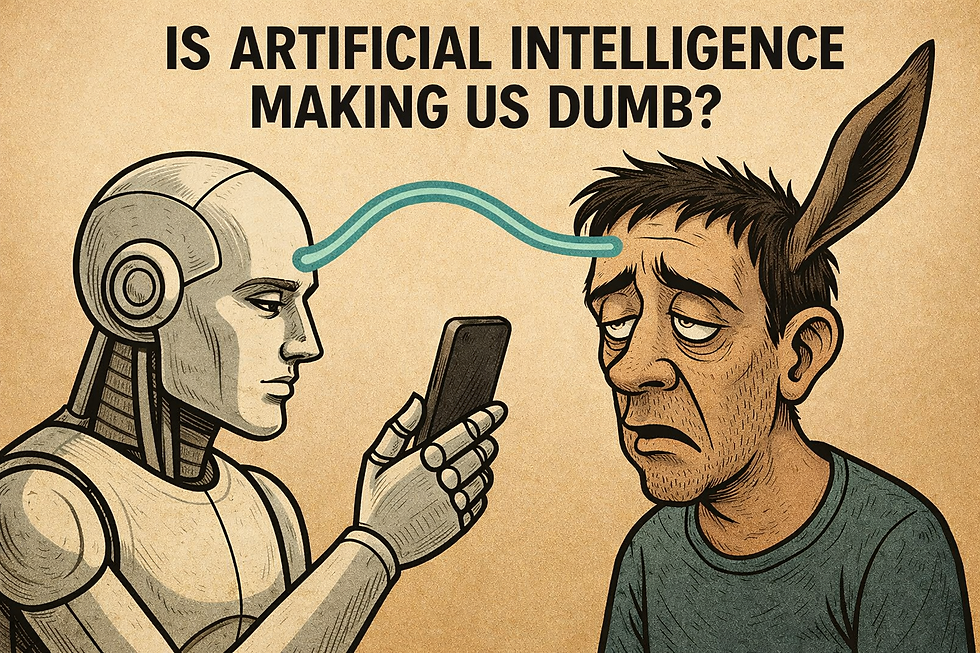
Why this debate is emerging and what it really means for companies and professionals
The question many have been asking: “Does artificial intelligence (AI) make us dumber?”, appears in talks, articles and corporate conversations. The short answer is: not necessarily. AI does not condemn us to automatic intellectual decline. At the same time, there are real risks of certain human skills being “worn down” if AI is applied poorly.
In this article we’ll explore the topic in depth: why this controversy is happening now, how to compare it with previous technological revolutions, what the real and avoidable harms of AI are, and how, with good practices, AI can be an outstanding ally. For those working with AI agents, chatbots and intelligent automations, understanding these nuances is essential.
The context: why do people ask whether AI makes us “dumber”?
We live in an era of accelerated adoption of AI systems, especially language agents, routine automations, decision-assistants, and more. Companies of all sizes are looking to implement AI agents that answer users, automate processes, and anticipate requests. The push is real: efficiency, speed, scale.
But alongside this push comes a shadow: excessive dependence on technology, the replacement of human skills, and possible loss of practice in tasks we used to perform. For example, a recent study pointed out that using generative AI at work can reduce effort in critical thinking:
“When people depend on generative AI […] their effort shifts to checking whether the AI’s answer is ‘good enough’ […] instead of using higher-level critical thinking skills.”
Another study on automation and AI finds that using automated systems can lead to “human inattention,” for example pilots using autopilot forgetting to monitor the flight properly.
Thus, the hypothesis of “dumbing down” gains traction. But before concluding that AI makes us less capable, it’s vital to view this debate from a historical and technological perspective.
Comparing with other technological revolutions
Why this fear has always existed and why it doesn’t always hold up
When we look at major technological revolutions of the past, a recurring pattern appears: a new technology promises to free humans from heavy or repetitive tasks and immediately raises the question: “Will this weaken our abilities?”
Some examples:
The invention of the printing press in the 15th century freed many from copying manuscripts, which led to fears that “human memory” would shrink.
The arrival of calculators and later spreadsheets (1970s–80s) made many wonder whether people would still need mental arithmetic or build models by hand.
The rise of the internet and search engines: in the famous article Is Google Making Us Stupid? (2008), Nicholas Carr asked whether searching for information online was reducing our depth of reading and reflection.
All these technologies brought enormous benefits like greater access to information, task automation, scale, but also challenges: memorization became less central, building things from scratch became less necessary in many activities, and debates arose about what we might be “losing.”
With AI the situation is similar but with some differences: the speed of adoption, the level of autonomy of systems, and the cognitive nature (language, reasoning, analysis) of AI agents create particular unease.
Important: technological revolutions did not automatically make humans “less intelligent” or “incapable.” They changed which skills are most relevant, how we use them, and what is expected of us. AI will follow that pattern, but requires that we manage the transition consciously.
What are the possible harms of AI?
When we speak of harms from AI, it’s important to distinguish them: it’s not that AI is “evil” in itself, but how its use (or abuse) can generate negative effects. Let’s look at the main ones:
1. Erosion of cognitive / critical skills
As mentioned, there is evidence that using AI as a constant “shortcut” can weaken certain human capacities for analysis, creation and judgment. A study published in Cognitive Research noted:
“Automation can also lead to bias and complacency […] users tend to favor information coming from automated systems […] even when recommendations conflict and automated suggestions are inaccurate.”
When we rely too much and stop exercising our own thinking, we risk losing the “muscle” of reasoning. That doesn’t mean AI makes us stupid, but rather that some cognitive pathways may be under-activated.
2. Technological dependence and “button-pushing” operation
If a company comes to depend on AI agents for tasks previously performed by humans, without good practices for oversight, verification, or human involvement, there is a risk of:
losing familiarity with the process
reduced ability to respond if the system fails
demotivation/alienation of humans who are “just supervising”
For example, a TechRadar report warned about “skill erosion,” where employees used to automations could no longer perform basic tasks when the system was removed.
3. Substitution or displacement of skills?
AI adoption affects the job market and demand for certain skills. Research titled “Complement or substitute? How AI increases the demand for human skills” shows that while traditional routine skills tend to decline, skills complementary to AI (e.g., critical thinking, creativity, digital ethics) gain importance.
4. Bias, transparency and reduced oversight
Often AI systems operate as “black boxes.” Teams may trust automated answers without understanding how they were generated, which opens the door to undetected errors. This “automation bias” happens when humans over-trust the system and stop exercising critical control.
5. Loss of human agency and motivation
Another subtle harm: when tasks are overly automated, there can be a reduction in sense of agency, motivation and human engagement. A recent study found that higher levels of automation were associated with lower sense of agency and reduced risk-taking.
So why doesn’t AI “make us dumb” if used well?
Despite these risks, it’s crucial to stress: AI is a tool, and like any tool it can be used either to multiply human capacities or, conversely, to suppress their development. The key is design, implementation and culture of use.

AI as an amplifier of human capability
In well-designed contexts, AI complements humans. It takes on repetitive or routine tasks, freeing people to focus on what truly requires human intelligence: creativity, empathy, judgment, adaptation. A recent study shows that the complementarity effect of AI (i.e., AI that enhances human skills) can be up to 50% stronger than the substitution effect.
Consulting firm McKinsey & Company points out that by 2030 there is expected growth of 50% in the use of “advanced technological skills,” meaning those who understand, adapt and innovate with AI will be valued.
In companies that implement chatbots and AI automations, there are productivity gains and knowledge transfer: AI agents help disseminate better practices and accelerate the learning curve of less experienced employees (example quoted by the Financial Times).
Why human competence remains irreplaceable
Deep human intuition, contextual understanding, moral sense, empathy and judgment remain areas very difficult for AI to replicate. A review study on AI and human work concluded that “AI […] has difficulty imitating creative endeavors and emotional intelligence […] reminding us that the essence of the human experience is irreplaceable.”
Polanyi’s Paradox indicates that some of our knowledge is tacit and hard to formalize, which still limits AI in many contexts.
Adding a technical layer, we can mention the P vs NP problem from complexity theory: if P ≠ NP (the majority hypothesis), then there are problems whose solutions are easy to verify but not known to be efficiently solvable. Tasks that depend on tacit knowledge or many unpredictable inputs resemble those where finding solutions is harder than verifying them, suggesting that full automation of such tasks may be impractical in a reasonable horizon, so some human skills may remain “beyond automation.”
The role of automation design
The difference between AI that “substitutes” and AI that “empowers” is crucial. The risk lies more in poor design and unrealistic expectations than in the technology itself. As Prof. Raffo wrote in an ACS-Australia editorial: “We have a real problem […] when tools do the work, people don’t learn the skills.”
Therefore, AI becomes harmful when used as a lazy substitute for thinking. But when used as an assistant to amplify human capability, it can have a positive impact.
Suggested framework for companies implementing AI: how to avoid AI harms and maximize value
For companies and teams working with automations, AI agents and intelligent chatbots, here’s a recommended structure:
Map tasks and human skills before AI: Understand which tasks are repetitive, routine or low value-added and which depend on human judgment, creativity or empathy. Ask: “If we automate this, what human skills remain? Will the human still have meaningful work or just supervision?”
Define AI’s role as complement, not substitute: Ideal AI automation is where human and machine collaborate. The AI agent handles the mechanical part (answering simple questions, triage, data collection) and humans handle analytical or emotional parts. Example: an internal chatbot that does pre-service and then hands the case to a human with enriched context.
Develop complementary human skills: With AI in place, skills that matter most now are critical thinking, digital ethics, AI oversight, creativity and adaptability. Invest in training so the human team knows how to interact with AI, control results, and keep the “thinking muscle” active.
Maintain oversight, measurement and feedback loops
Create KPIs not only for efficiency (e.g., number of interactions per hour) but also for human quality (e.g., satisfaction level, degree of human judgment applied).
Conduct regular audits to ensure AI is not producing wrong answers that humans accept uncritically (avoiding automation bias).
Promote a culture where AI assists but humans validate. This avoids complacency.
Preserve human learning trajectories
During onboarding or training, allow new employees to perform tasks “the old-fashioned way” to understand the full process before using AI as a shortcut.
That way, if automation is removed or fails, the team will still know what to do, avoiding “skill erosion” risk.
Encourage use of AI as a study “buddy” or internal “coach,” not as an automatic doer.
Communicate the proposition and human control
Be transparent about where AI is used and what the expected limits are. This builds internal and external trust.
Encourage humans to ask: “Why did the AI suggest this?” or “How was this result obtained?” to promote engagement and healthy critique.
Summary: what can we conclude?
AI does not automatically make us dumb. But if used passively as a substitute for thinking, it can lead to atrophy of certain human capacities (critique, analysis, adaptation).
The “harms of AI” stem not from the technology itself but from misuse, lack of human-centered design and a culture lacking supervision and learning.
Historically, all major technological revolutions caused similar debates; what changed was not human intelligence, but the kind of intelligence that was valued.
For companies implementing automations and AI agents, the challenge is clear: use AI to amplify and expand human capabilities, not to reduce humans to mere button-pushers.
The path is to apply AI strategically, focusing on complementarity, human training, transparency and critical supervision.
Ready to be the next AI success story?
Now it’s your turn.
The future of business is already intelligent. Those who anticipate it reap the greatest benefits. Talk to our specialists and discover how to apply AI agents strategically and safely in your company. Transform. Grow with AI.




Comments